Hi My name is Victor I will help you learn more about your lawn, and the value you should have in it no matter what the objective. We will go through the reasons you should value your lawn and the differrent things that a lawn produces for you pleasure and satisfaction, why it's good to call us or make an email appointment with us so we can have a person to person talk about how we can improve you appearance and care of the lawn. We offer a varietiy of experence and skilled care, and are goal is to help each and everyone of our customers to know their objectives, better and create one if needed.
Posted by Duncan Gray in Grass Types | here are literally hundreds of different grass types which, to the layman, mostly look the same. It’s green, it’s grass, after all! Well, the fact is that as far as our lawns are concerned in most of the US, there are only five types of grass that really matter. They are chewings fescue, creeping red fescue, brown top bent, perennial ryegrass, and annual meadow grass.
In this article I’m going to talk a little about these types of grass and when you should be using them. I hope you find answers to your questions, and remember, once you’ve decided what grass type you need, stop by the grass seed department in our shop to pick up a bag, with free delivery included.
Grass Types, or Cultivars?
So, we’ve already talked about the fact that there are many different types of grass growing around our planet. Well, to complicate matters even further every type of grass has a vast number of what are called cultivars, a term used to describe interbreeding of grasses to combine the best characteristics in one plant for any given application. For example, high drought tolerance or very good wear resistance.
Again, this is something that really doesn’t need to be taken into consideration unless the lawn in question is being maintained with a specific objective in mind, say possibly as a putting green or croquet lawn.Common in US Grass Types
1. They are chewings fescue, creeping red fescue, brown top bent, perennial ryegrass, and annual meadow grass
The most common grass found in US and other temperate climate lawns is perennial ryegrass as it has historically been substantially cheaper than any of the others, and is also seen as being very resistant to heavy use. This is mainly because of the fact it is a fast growing grass which recovers quickly when put under stress, certainly a very useful trait when, for instance, being used as a play area.
The downside is that it requires very regular mowing, at least twice per week, needs substantial fertilizer input to keep it healthy, and produces large amounts of cuttings which then have to be disposed of. For these reasons alone I would always advise against the use of ryegrass on its own, even though the modern cultivars are a lot finer leaved and slower growing than in the past.
The other grass most commonly found in UK and temperate US lawns is annual meadow grass, even though it is never introduced deliberately. This is because it is classed as a weed grass, successfully colonising and surviving in the most inhospitable places such as cracks in pavements because of its ability to produce huge amounts of seed and its dense, shallow rooting system.
Because of its opportunist nature, annual meadow grass will quickly take hold in any areas of bare soil in a lawn caused by wear, disease etc, more of which later. You might think this trait might be good in a grass, but as its name suggests it is an annual grass, dying or becoming very weak in the winter, and then reproduces by producing copious amounts of seed heads which are very unsightly in any lawn. Some of the meadow grass plants will survive and become more of a perennial but are still less hardy than the others.
2.
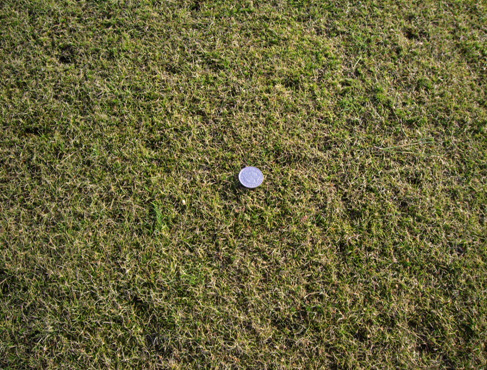
A fescue/bent lawn looking good even in January
This brings me to the other three grass types I mentioned above, creeping red fescue, chewings fescue, and brown top bent. These are the grasses most commonly used on golf courses and bowling greens as they are fine leaved, slow growing, and naturally deep rooted. This is because they are the grasses indigenous to infertile ground such as linksland, the sand dunes and salt marshes between land and sea, and heathland.
These characteristics are highly desirable in any grass sward as they require less water, less fertiliser, and most importantly, less frequent mowing . The best ground cover is achieved by a mix of two, or even all three, of these grasses , as the growth habits complement each other, and any problems with disease will normally only affect one of them at a time, so restricting the damage.
An Ideal Mix of Grass Types
Looking at all that I have talked about above, the ideal lawn, therefore, would be one that can be constructed from the base up using free draining materials and topped off with fescue and bent grasses. In reality, though, most existing lawns are built on far from ideal ground with all sorts of grass cover, some good, some not so goodLead-in text goes here
achieved by a mix of two, or even all three, of these grasses , as the growth habits complement each other, and any problems with disease will normally only affect one of them at a time, so restricting the damage.
An Ideal Mix of Grass Typess in the comments area below and I’ll do my best to answer them.
Duncan has been a Golf Head Greenkeeper thirty five years, with experience in sports pitches, public parks and bowling greens, including the world bowling championships at Ayr Northfield. Since 1991 he has run a turf advisory company, including Lawn Care services, and this has now morphed into Lawns For You and the site you see today. More about Duncan...Google+ Duncan
My husband and I decided to landscape our yard to conserve water with places for our kids to play and explore. We also wanted to make it dog-friendly (greyhound-proof) and make it aesthetically appealing for adults. All of this on a DIY budget.
Natural play areas for children are a hot landscaping feature in 2013.
Once homeowners used to adapt their landscaping design to what they thought a future buyer might want. But with more home owners staying put, these days landscape designers say that homeowners are instead adapting their yards and gardens to suit their own needs.
HGTVGardens asked a host of in-the-know designers to share the top trends they are seeing around the country.
Low Maintenance Landscapes
Traditional lawns are undergoing a dramatic makeover. Aiming to spend less money, less time and reduce the use of fertilizers and weed killers, homeowners are choosing lower-maintenance grasses.
“There is a type of Pennisetum that's a cross [hybrid] that they created at Texas A&M. We use it quite a bit. They call it “kick ass” grass. It's just a real heavy-duty grass that doesn't need much water and when it gets it, it kind of blows up. That's the kind of thing people are looking for” says Austin, Texas landscape designer Mark Word.
“I find that people are getting away from high maintenance grasses like fescue, reducing the yard and going to a lower maintenance grass like a zoysia that takes fewer chemicals. In the other areas, they're allowing them to become more naturalized. They're replacing bushes that need pruning every two to three weeks with bushes that grow to their proper size without the need for pruning,” says Georgia landscape designer Eric King of King Landscaping.
Drought-tolerant plants are also big sellers these days.
"People just don't want to pay that water bill so they're tending to plant more drought tolerant plants. What I'm also seeing my clients do is minimize the amount of turf they have in the yard, especially when it comes to competition with tree roots” says Dan Eginton of Scenic Design Group.
Souped-Up Outdoor Spaces
Once upon a time homeowners would plop on a screened-in porch or deck and call it a day. But today's outdoor spaces have become a tricked-out extension of the indoors, decked out with functional kitchens, fireplaces, barbecue pits and flat screen TVs.
Image courtesy of King Landscaping with MOSAIC Group. Photo by Gregg Willett
The new outdoor room features luxurious features, fireplaces, fans, beautiful fabrics and treatments to make outdoor space as well-appointed as indoor.
“There are so many accoutrements that you can put out there: floor lamps and table lamps, all kinds of fabrics for cushions and chairs that are all-weather. There are rugs that are made to go outdoors. There's art that you can hang up outdoors. Everything that used to be indoors you can virtually buy for outdoors and those accessories really complete the space and make it feel more like an indoor room," notes King. To keep things more comfortable in steamy Southern regions, misting fans, insect barriers and decorative awnings are popular.
Edible Yards
Not content to just grow a patch of vegetables in raised beds, homeowners are now converting their entire yard into year-round edibles with fruit trees, berry bushes and medicinal herbs. Edible yards are both colorful and useful. Provide order to the space and showcase your plants by creating distinctive borders or lines with evergreens, hedges or sculpture.
Natural Play Areas
The temporary swing sets, trampolines and plastic kiddie pools that once defined the "kid's zone" section of the yard are being transformed into something far more beautiful and long-lasting. Influenced by the writing of Richard Louv in Last Child in the Woods: Saving Our Children from Nature Deficit Disorder, parents are creating exploratory spaces, mini-forests and woodlands where nature—not a plastic slide—provides the play.
Richard Louv, says King, “done a lot of research showing the benefits to children of spending unstructured playtime outside. That's not soccer. That's hiking through the woods, picking up sticks or making a fort out of old rotten logs. He's found that that unstructured playtime is different than playing football."
"We're also trying to make the yard a little more wild. So you can do that by adding a dry creek bed. Maybe the down spouts [from your rainwater runoff] lead to a little area with stones and goes under a little bridge. Or you might have a big pile of sticks the kids can make into a fort…One yard we brought in big boulders and kids just love rocks. They'll jump from rock to rock, they'll hide behind them, they'll make a bridge across them. So that's the trend—making the yard more interactive and interesting for children for more unstructured creative free play.”
Vintage items like old bird cages, picture frames, shutters and seed boxes are trending right now. Designer James Farmer is a fan of Perky-Pet Mason Jar Bird Feeders, "reminiscent of the vintage blue glass canning jars used in the 1800’s.” Hit thrift stores and yard sales to find items like antique coffee cans or water jugs, crates or cloches that can make for unique containers or just a quirky design flourish in your garden.
Image courtesy of Mark Word
One way to bring design impact and color to an outdoor scheme is by incorporating colorful tiles.
Color Rules
Bold purples, metallics, yellows and blues are big in garden decor. Mark Word likes to add color to the garden using bright tiles.
“We're starting to do a lot of hand-painted tiles or hand-done tiles that come out of Mexico," says Word. "It's a good value compared to if you are doing a real fine stone or something that has real depth to it - that's fairly expensive material.”
Great article and I especially like the thoughts of getting the young ones back to the outdoors and nature. Way too many are missing the enjoyment the forests and backyards that a lot of us grew up in. Doing some of these projects and getting back to basics verses all of the electronics would do us good. Excellent tips in utilizing a lot of the older items, which I see here being used more and more.
Use gravel, pebbles and bark chips for practical, versatile garden design.
ou can share information about an event, interest, or hobby with others by writing an article about it. Click on the edit button below to replace this text with text of your own.
You can choose to include a byline or a photo with your article. If you don't wish to use either, you can simply click edit, and delete the parts you don't want, or choose "Don't show a photo".
Sub-heading
You can include as many entries on a page as you wish, and they can be as long or as short as you would like. Your entries can contain tables, lists, or links to other pages or photos.
List of items
Item 1
Item 2
Item 3
You can include as many entries on a page as you wish, and they can be as long or as short as you would like. Your entries can contain tables, lists, or links to other pages or photos.





1 Comments About this Article